

5 Digital Marketing Strategies That Grow Your Business
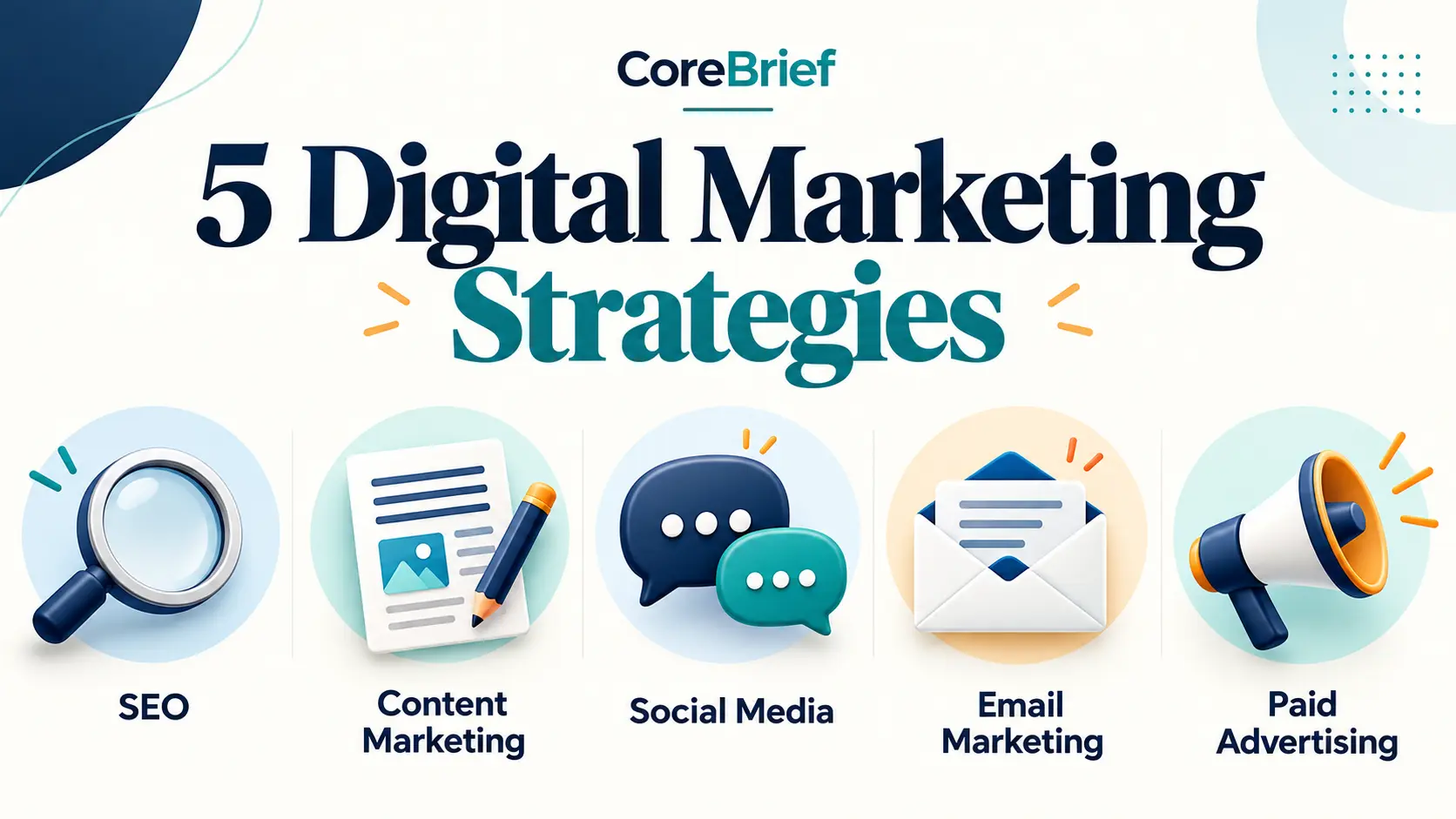
Digital marketing strategies help businesses attract customers, earn their trust and turn interest into sales. The five main strategies are search engine optimisation (SEO), content marketing, social media marketing, email marketing and paid advertising. Together, they cover how people discover a business, evaluate its offer and decide whether to buy.
There is no official rule that marketing must fit into five categories. Affiliate partnerships, influencer campaigns and other approaches also matter. But these five give beginners and business owners a useful foundation without making the subject unnecessarily complicated.
Picture a small homeware shop. Someone finds its guide to choosing a desk lamp, watches a product demonstration, subscribes for decorating ideas and eventually buys. Each interaction has a different job. Well-planned digital marketing strategies connect those jobs instead of expecting one advertisement to do everything.
What are the five main digital marketing strategies?
Here is the quick comparison before we look at implementation:
- SEO helps people discover your website through unpaid search results.
- Content marketing answers questions and gives people reasons to trust you.
- Social media marketing builds awareness and conversations around your business.
- Email marketing develops relationships with subscribers and existing customers.
- Paid advertising buys distribution to reach relevant audiences and generate measurable actions.
The best digital marketing strategies start with a business goal. “Get more followers” is incomplete. “Generate qualified enquiries for our installation service” gives your content, targeting and measurement a clear direction.
1. Search engine optimisation to capture existing demand
SEO makes your website easier for search engines to understand and more useful to people searching for your products or expertise. It can connect you with someone who already has a problem you solve.
For example, a lighting retailer could create a useful page about desk lamps for small workspaces. That page should explain dimensions, positioning and practical trade-offs, then link to relevant products. Repeating a keyword without helping the buyer adds little value.
How to build an SEO strategy
Begin with the questions customers ask before purchasing. Separate informational searches, such as “how to light a home office,” from commercial searches, such as “buy adjustable desk lamp.” These queries usually need different pages.
Write clear titles, use descriptive headings and connect related pages with helpful links. Check that important pages can be crawled and indexed, work well on mobile and make the next step obvious. Google’s SEO Starter Guide provides a reliable foundation for these checks.
Among digital marketing strategies, SEO is useful for building ongoing discovery. However, results take time, and publishing a page does not guarantee visibility. Review relevant search impressions, clicks and enquiries rather than celebrating rankings that attract the wrong audience.
Make answers easy to understand
Answer a heading’s question immediately, then add detail and examples. This helps readers scan and understand the page. Google’s guidance on AI search features also keeps foundational SEO relevant to AI discovery. Clear answers can support usability and citability, but they do not guarantee an AI Overview mention.
2. Content marketing to answer buying questions
Content marketing means creating material that helps a specific audience solve problems or make decisions. Articles, demonstrations, comparison guides, newsletters and case studies can all serve that purpose.
SEO and content overlap, but they have different roles. SEO helps people find a useful guide; the guide itself must explain the subject well enough to earn their attention.
Imagine selling office chairs. A generic post saying “our chairs are comfortable” tells readers very little. A practical guide explaining seat depth, adjustable armrests and room measurements helps them evaluate their options.
Create content around the customer journey
When planning content within digital marketing strategies, consider three moments: discovering a problem, comparing solutions and choosing a provider. A beginner guide can introduce a topic. A comparison can explain trade-offs. A detailed product page can answer delivery, suitability and support questions.
Effective digital marketing strategies need this connection between education and action. Give each piece a sensible next step, such as viewing a relevant service, downloading a checklist or requesting a consultation.
Your content should also remain useful after publication. Check examples, update broken links and remove claims you cannot support. CoreBrief’s digital marketing updates guide offers related reading on platform developments; check the dates and original announcements before applying a change to your campaigns.
Measure whether readers continue to relevant pages, subscribe or make qualified enquiries. Traffic is useful, but it needs a connection to your business objective.
3. Social media marketing to build familiarity
Social media marketing helps people discover your business, see how it works and talk to you. A helpful reply or an honest demonstration can answer concerns that a polished sales page misses.
Avoid choosing a channel simply because it is popular. Look at where your actual customers spend time, what they discuss and which formats your team can produce consistently. For small businesses, sustainable digital marketing strategies rarely require launching on every platform at once.
Build a manageable social media strategy
Choose one primary audience and a few repeatable content themes. For the homeware shop, those might be small-room advice, product demonstrations and answers to customer questions.
A weekly schedule could include one practical demonstration, one useful tip and one response to a common buying concern. These are starting ideas, not a universal posting formula. Adjust the schedule to your production capacity and audience response.
Social media works best within digital marketing strategies when it connects attention to a useful destination. A demonstration should lead to the demonstrated product or a relevant guide. Sending everyone to a crowded homepage creates extra work for the visitor.
Look beyond likes. Track relevant website visits, meaningful conversations, qualified messages and sales where attribution is available. Also ask customers how they heard about you; not every useful interaction appears neatly in an analytics report.
4. Email marketing to nurture leads and repeat purchases
Email marketing keeps a direct conversation going with people who have chosen to hear from you. It can welcome new subscribers, explain an offer, provide useful advice and support repeat purchases.
Someone downloading a buying checklist may need education. An existing customer may want care instructions or compatible accessories. Sending both people the same repeated sales pitch misses that difference.
Make email useful before making it frequent
Offer a clear reason to subscribe and explain what readers will receive. A short welcome sequence could deliver the promised resource, answer a common question and introduce a relevant product or service.
Group subscribers by meaningful signals, such as expressed interests or purchase history. Mailchimp’s customer segmentation guide explains how shared characteristics can inform more relevant messages.
Email strengthens digital marketing strategies by giving interested visitors a reason to return. Each message should have a clear purpose and an easy next step. Keep subscription choices transparent and make unsubscribing straightforward.
Measure clicks, enquiries, purchases and unsubscribe trends. Open rates can be affected by how email applications handle privacy and images, so avoid treating an open as proof that someone read the message.
A smaller list of interested subscribers can be more useful than a large list of people who never asked to hear from you.
5. Paid advertising to reach customers with a clear offer
Paid advertising places your message in purchased placements, such as search results or social feeds. Pay-per-click advertising describes a payment model in which an advertiser pays for clicks; not every advertising campaign uses that model.
Search ads can reach people actively looking for a solution. Social advertising can introduce an offer while people browse. These situations call for different messages and expectations.
Start with the conversion you want
Choose an action that matters: a purchase, a booked appointment or a qualified enquiry. Then build a landing page around that action and test the form or checkout before spending money.
For keyword-led campaigns, Google’s Keyword Planner guidance explains how to explore ideas and search-volume estimates. Review location and intent carefully; a broad term can attract many people who are unlikely to buy.
Paid campaigns belong in digital marketing strategies when the economics make sense. Monitor cost per qualified lead, customer acquisition cost and revenue alongside advertising spend. Cheap clicks are not automatically good results.
Use a budget you can evaluate responsibly. If enquiries are irrelevant, inspect the targeting, search terms, offer and landing page before increasing spending. Advertising can expose a weak offer quickly, but spending more does not fix it.
How to combine digital marketing strategies in 30 days
Putting digital marketing strategies into practice does not require five large campaigns running immediately. Start with a simple customer journey and make each step useful.
Week 1 — Choose one goal and audience
Define the customer, the problem and the desired action. Review your main landing page on a phone. Check that contact details, pricing context and next steps are easy to understand.
Week 2 — Create one strong resource
Publish a guide addressing a real buying question. Add relevant product or service links, a clear answer near the beginning and an original example. Use SEO principles to make the page understandable and discoverable.
Week 3 — Distribute and follow up
Turn the guide into a short demonstration and a few social posts. Offer a relevant subscription option and prepare a useful welcome email. CoreBrief’s AI digital marketing tools for SEO, ads and automation can help you explore supporting tools; review their capabilities and costs before choosing one.
Week 4 — Measure and improve
Review the full journey from visit to enquiry or purchase. If people arrive but do not act, investigate the page before buying more traffic. If the offer converts and you have a suitable budget, consider a focused paid campaign.
Review digital marketing strategies together. A customer may discover you through search, return through email and purchase after seeing a demonstration. Giving all the credit to the final click can hide useful earlier interactions.
Five frequently asked questions
What are the 5 main strategies of digital marketing?
The five main digital marketing strategies are SEO, content marketing, social media marketing, email marketing and paid advertising. They help businesses attract visitors, explain their value, build relationships and encourage purchases. This is a practical framework rather than an exhaustive list of every marketing approach.
Which digital marketing strategy is best for small businesses?
The best starting strategy depends on customer behaviour, budget and the offer. A local service business may prioritise local search visibility and useful service pages. A business with an engaged subscriber list may focus on email. Choose one acquisition channel first, then add supporting activities.
What is the difference between SEO and content marketing?
SEO improves how a website can be discovered and understood through search. Content marketing creates useful material that informs and persuades an audience. They work together when a helpful article answers a search query and guides readers toward an appropriate next step.
How long do digital marketing strategies take to work?
Timelines depend on the channel, competition, offer and starting position. Paid campaigns may generate visits once approved and running, but profitable results require evaluation. SEO and content generally need a longer runway. Measure progress against realistic milestones rather than expecting every channel to produce immediate sales.
How do you measure digital marketing success?
Measure success against the business goal: qualified leads, completed purchases, acquisition cost or repeat revenue. Use channel metrics to diagnose performance, then connect them to outcomes. Check lead quality and profitability before increasing investment; more traffic alone does not prove that marketing is working.
Build a plan you can actually maintain
Strong digital marketing strategies connect discovery, useful information and a clear next step. Choose one customer problem, create a helpful destination and distribute it where your audience already pays attention. Keep the activities you can sustain, measure what happens and improve the weakest part of the journey before adding more channels.

