
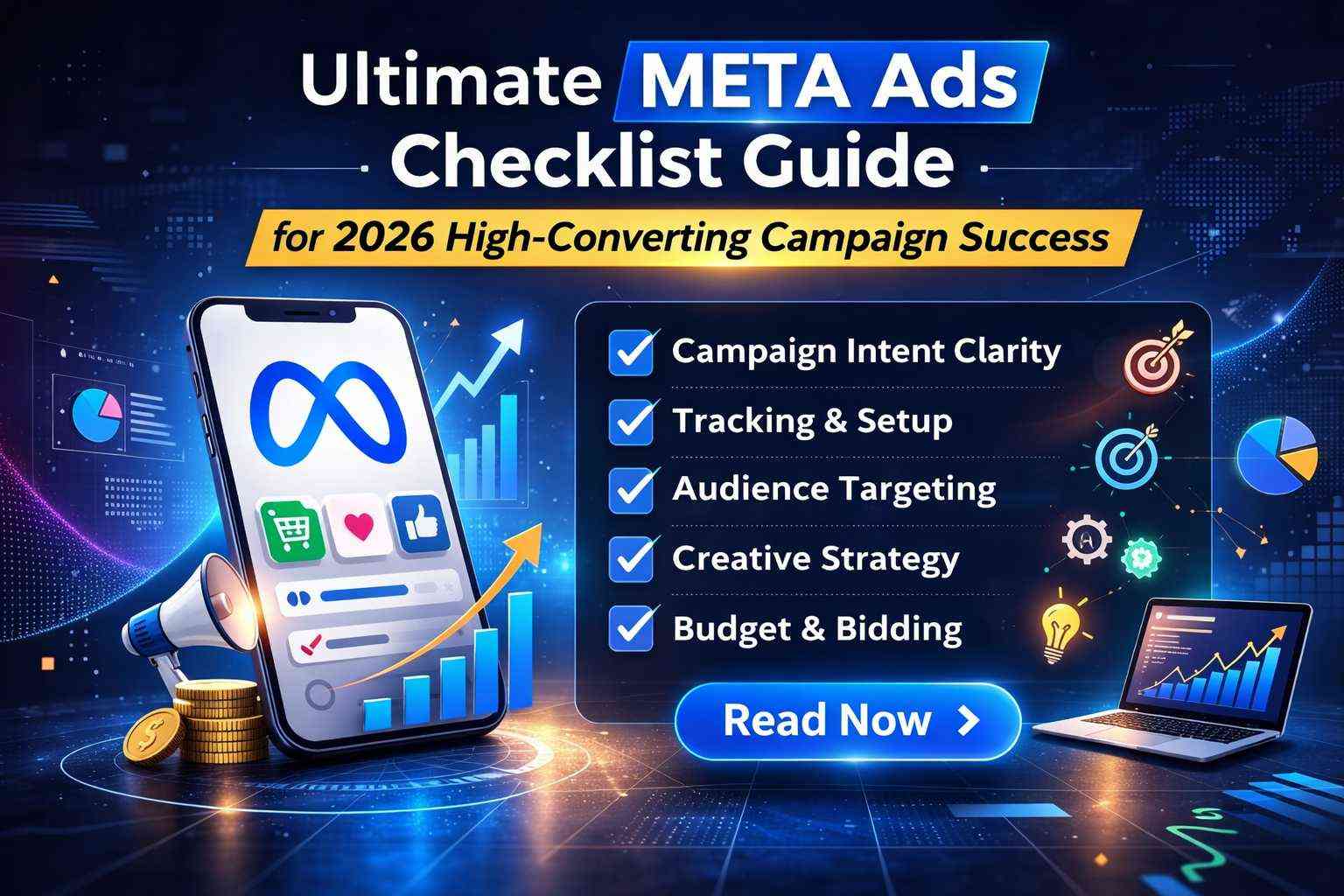
Ultimate META Ads Checklist Guide for 2026 High Converting Campaign Success
Running paid ads without structure leads to wasted budgets and inconsistent results. The advertising landscape on Meta is more competitive than ever. Costs are rising. Attention spans are shrinking. Algorithms are smarter.
This is where a structured META Ads Checklist becomes essential. Instead of guessing what works, you follow a proven system. A system built on real campaign audits, data analysis, and hands on performance marketing experience.
This guide walks you through a complete META Ads Checklist using 10 powerful pillars. Each section contains actionable checkpoints you can apply immediately to improve conversions, lower CPA, and scale profitably.
If you want to safe you ROI so please check this 10 Meta Ads mistakes.
Now let us break down the exact system serious advertisers use to win in 2026.
1 Campaign Intent Clarity
Before launching any campaign, you must define intent clearly. Most failed campaigns start with confusion at this stage.
Key Points
- Select the correct campaign objective- Choose Sales for purchases, Leads for form fills, Traffic for website visits, or Engagement for visibility. Never mismatch objectives.
- Define the funnel stage- (TOF)Top of Funnel for cold audiences, (MOF) Middle of Funnel for engagement retargeting, (BOF) Bottom of Funnel for high intent buyers
- Set measurable KPIs- Define target CPA, expected ROAS, acceptable CPL, and minimum CTR benchmarks before launch.
- Align budget with goal- High competition industries require higher testing budgets. Underfunded campaigns rarely succeed.
- Confirm tracking before going live- Test all conversion events to ensure accurate optimization.
Clarity at this stage determines how efficiently Meta’s algorithm works for you.
2 Account and Tracking Setup
A META Ads Checklist is incomplete without technical accuracy. Tracking is the backbone of optimization.
Key Points
- Install Meta Pixel correctly- Verify installation using Meta tools to ensure event firing is accurate.
- Connect Conversion API- CAPI improves data reliability and reduces tracking loss due to browser restrictions.
- Configure standard events- ViewContent, AddToCart, InitiateCheckout, Purchase.
- Set Aggregated Event Measurement- Prioritize events in order of business importance.
- Verify domain ownership– Domain verification improves event tracking stability and protects your ad account.
Accurate tracking leads to better machine learning performance and smarter delivery.
3 Audience Strategy
Targeting has evolved. It is no longer about stacking random interests. It is about strategic audience planning.
Key Points
- Research core audience deeply- Understand demographics, buying behavior, and psychological triggers.
- Build custom audiences- Website visitors, Video viewers, Page engagement users, Email lists
- Test lookalike audiences- Start with 1 percent for precision, Expand to 3 to 5 percent for scaling
- Exclude existing customers- Prevent budget waste in prospecting campaigns.
- Balance audience size- Too narrow limits delivery, Too broad reduces relevance
Audience clarity increases conversion probability significantly.
4 Creative Strategy
In 2026 creative is the biggest performance driver. Algorithms distribute ads. Creatives convert users.
Key Points
- Hook users in first 3 seconds- Start with bold statements, questions, or strong visuals.
- Use problem solution structure- Identify pain point- Present clear solution- Show transformation
- Add social proof- Customer testimonials- User generated content- Ratings and reviews
- Test multiple creative formats- Short videos, Reels, Carousel ads, Static images
- Rotate creatives regularly- Refresh every 2 to 3 weeks to avoid fatigue.
High performing creatives lower CPC and increase ROAS dramatically.
5 Copywriting Optimization
Compelling copy bridges attention and action.
Key Points
- Write benefit driven primary text- Focus on outcomes rather than features.
- Keep messaging simple and clear- Avoid jargon and complex language.
- Use emotional triggers- Scarcity, Urgency, Trust, Authority
- Include strong (CTA) call to action- Buy Now, Learn More, Book Your Spot
- Optimize headline for intent- Spark curiosity or highlight value proposition.
Strong copy improves CTR and conversion rate simultaneously. You can take help with Best AI Writing Tools & Free AI Tools (2026)
6 Offer and Landing Page Alignment
Even the best ad fails if the landing page disappoints.
Key Points
- Create a compelling offer- Discounts,Bundles, Free bonuses, Guarantees
- Ensure message match- Ad headline must match landing page headline.
- Improve page speed- Load time should be under three seconds.
- Design for mobile first- Majority of Meta traffic comes from mobile users.
- Simplify conversion process- Reduce unnecessary form fields,Clear checkout flow
Alignment between ad and landing page increases conversion rate significantly.
7 Campaign Structure and Testing
A clean structure improves clarity and scalability.
Key Points
- Use ABO for testing, Use CBO for scaling
- Limit audiences per ad set, One or two audiences per ad set ensures clean data.
- Include multiple creatives, Test at least three creatives per ad set.
- Follow naming conventions, Use consistent campaign naming for easy tracking.
- Test one variable at a time, Avoid changing audience and creative simultaneously.
Structured testing prevents confusion and speeds up optimization.
8 Budget and Bidding Strategy
Financial discipline drives long term profitability.
Key Points
- Set realistic daily budgets, Allow sufficient data collection before judging performance.
- Scale gradually, Increase budget by 20 to 30 percent every few days.
- Use cost caps carefully, Only when data is stable.
- Avoid frequent edits, Editing resets learning phase and harms performance.
- Align budget with audience size, Larger audiences require larger budgets.
Smart budget management stabilizes performance during scaling.
9 Performance Monitoring
Launching campaigns is only the beginning. Monitoring determines profitability.
Key Points
- Track CTR- Low CTR signals creative weakness.
- Monitor CPC-High CPC may indicate targeting issues.
- Measure CPA and CPL-Ensure profitability aligns with margins.
- Calculate ROAS accurately-Revenue divided by ad spend.
- Watch frequency-High frequency leads to ad fatigue and declining performance.
- Consistent monitoring allows proactive optimization.
10 Scaling and Optimization
Scaling separates average advertisers from experts.
Key Points
- Pause underperforming ads quickly-Avoid emotional decisions.
- Duplicate winning ads- Expand into new audiences gradually.
- Refresh creatives consistently-Prevent audience fatigue.
- Maintain active retargeting campaigns-Retargeting improves overall ROAS.
- Make data driven decisions-Base scaling on metrics not assumptions.
Following this META Ads Checklist consistently builds predictable growth systems.
Frequently Asked Questions (FAQ)
What is a META Ads Checklist?
A META Ads Checklist is a structured framework used to launch audit and optimize Meta advertising campaigns for better performance and higher conversions.
How often should I use this checklist?
Use it before every campaign launch and during monthly performance audits.
What is the most important part of Meta Ads optimization?
Creative strategy and accurate tracking setup have the biggest impact on performance.
How long should I wait before optimizing a campaign?
Allow at least three to five days for campaigns to gather sufficient data before making major changes.
What is a good ROAS benchmark?
A healthy ROAS typically ranges from two to four times depending on profit margins and industry competition.
Why is creative more important than targeting now
Meta’s AI handles delivery optimization. High quality creatives determine engagement and conversion rates.
Conclusion
A successful advertising strategy is never random. It is systematic. The META Ads Checklist outlined in this guide provides a complete blueprint to launch optimize and scale campaigns confidently in 2026. When you focus on intent clarity strong tracking strategic audiences powerful creatives structured testing disciplined budgeting and continuous optimization you build campaigns that generate predictable results. Consistency wins. Structure wins. Data driven decisions win. Apply this checklist thoroughly and you will see measurable improvements in performance marketing outcomes.
Disclaimer: This content is for educational purposes only. Advertising results vary depending on industry competition budget strategy and execution quality. Always test and validate strategies within your specific business context before scaling budgets.