

Meta Location Fees 2026: The Critical Truth Every Advertiser Must Know Before July”
Meta has officially announced that starting July 1, 2026, Meta will begin charging location-based fees on top of your ad spend whenever your campaigns deliver impressions in six specific countries. If you are running ads in Austria, France, Italy, Spain, Türkiye, or the United Kingdom, your invoices are about to look different. Here is the complete, verified breakdown of what is changing, how fees are calculated, and exactly what you should do before July arrives.
What are Meta Location Fees 2026?
Meta location fees are additional charges that appear on your advertising invoice when your ads are delivered to users in countries where Meta faces government-imposed Digital Service Taxes (DST) or similar regulatory levies. These fees exist separately from your campaign budget and do not affect your Ads Manager spend figures.
Until now, Meta had been absorbing these costs internally. From July 2026, Meta is shifting part of this financial burden to advertisers, specifically to the portion of spend that actually reaches users in those taxed jurisdictions. This is confirmed in Meta’s official Business Help Center.
Key Point Location fees are triggered by where your audience is located, not where your business is registered. An advertiser in Mumbai running campaigns targeting UK users will be charged the UK location fee on those impressions.
The fees apply across all Meta advertising placements, including Facebook, Instagram, Messenger, Reels, Stories, and the Audience Network, covering any ad format that delivers impressions in an affected country.
New to Meta Ads or planning to scale? Start here before building your campaign structure for European markets.
Which Countries Are Affected and at What Rate?
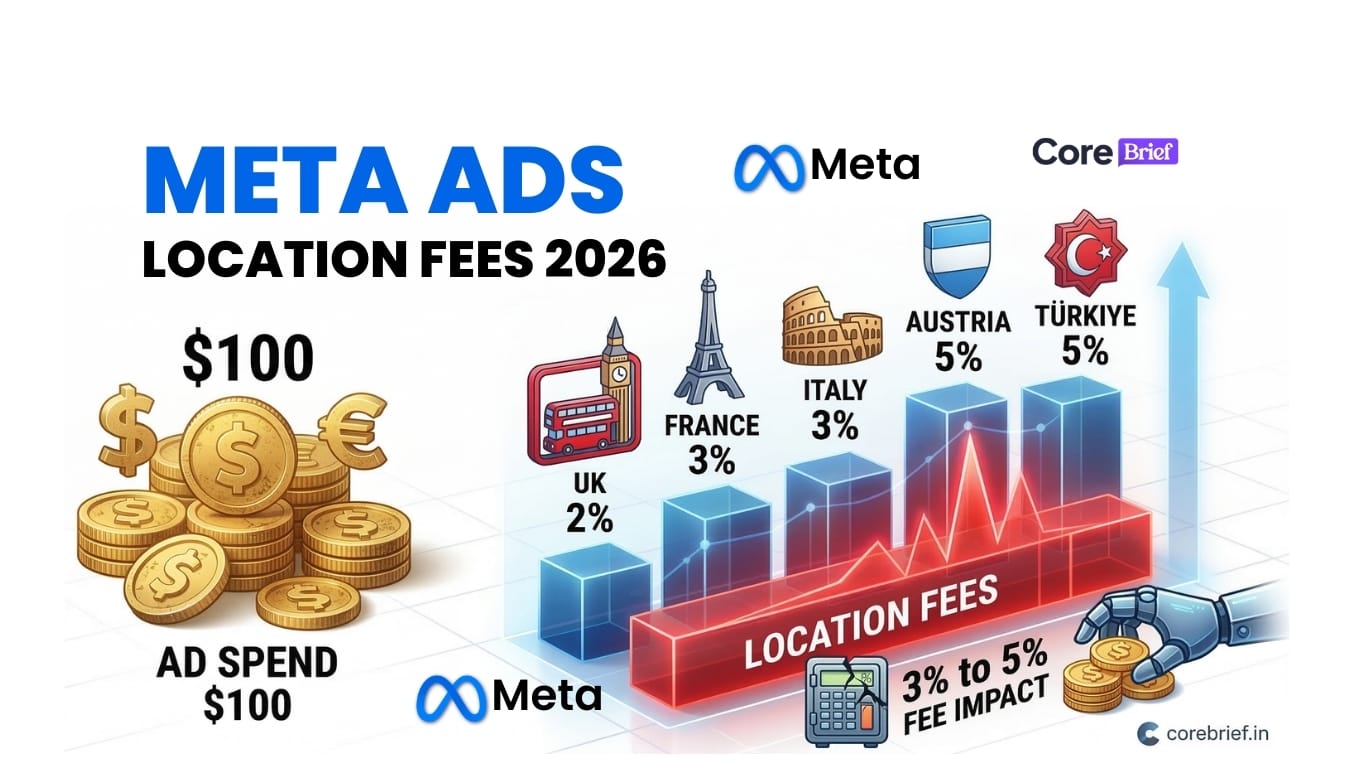
Meta has confirmed six jurisdictions for the initial rollout starting July 1, 2026. Each rate reflects the underlying Digital Service Tax that the respective government imposes on Meta. All rates below are sourced directly from Meta’s official Help Center and verified against multiple industry reports published in March 2026.
| Country | Location Fee Rate | Tax Type | Note |
|---|---|---|---|
| Austria | 5% | Digital Services Tax | Highest rate in the group |
| France | 3% | DST + Streaming Taxes | Extra 1.2% on music streaming, 5.15% on video streaming |
| Italy | 3% | Digital Services Tax | |
| Spain | 3% | Digital Services Tax | |
| Türkiye | 5% | Location-Based Levy | Tied with Austria for highest fee |
| United Kingdom | 2% | Digital Services Tax | Lowest rate, still a major market |
France: Watch Out for Extra Layers France has the most complex fee structure of any country on this list. In addition to the base 3% digital services rate, ads connected to music streaming content carry an additional 1.2% levy, and video streaming placements carry a separate 5.15% rate. Both reflect France’s own sector-specific media taxes confirmed in the 2024 Finance Law. If you are running video-heavy campaigns in France, your effective surcharge could be significantly higher than 3%.
Meta has explicitly noted that these jurisdictions and rates may change over time. Monitor Meta’s Help Center regularly, especially given that France has proposed increasing its general DST rate further.
How Are Location Fees Calculated?
The fee is applied after your ads are delivered, not before. Meta calculates it as a percentage of the spend attributed to impressions delivered in each affected country. Your campaign budget, bidding strategy, and Ads Manager figures are completely unaffected. The difference only shows up on your billing statement.
The Core Formula
Meta Location Fee Formula Location Fee = Ad Delivery Spend in Country × Fee Rate
Total Invoice = Ad Delivery Spend + Location Fee + VAT
VAT is calculated on (Ad Spend + Location Fee) combined
Example: $100 in Italy = $100 + $3 (3%) = $103 + VAT on $103
Multi-Country Campaign Example
Say you are running a ₹5,00,000 monthly campaign split across France, the UK, and unaffected countries. Here is how the location fee calculation works:
Multi-Country Fee Breakdown (Monthly) France delivery: ₹2,00,000 × 3% = ₹6,000
UK delivery: ₹1,50,000 × 2% = ₹3,000
Other countries: ₹1,50,000 × 0% = ₹0
Total extra cost: ₹9,000 per month / ₹1,08,000 per year
Advantage+ Campaigns and Broad Targeting: A Hidden Risk
If you are using Advantage+ campaigns or broad geo-targeting with no country exclusions, Meta’s algorithm may be delivering impressions into affected countries already, even if you never explicitly targeted them. These impressions will generate location fees from July 2026 onward. Pull your geo delivery report in Ads Manager now to see how much of your current spend is landing in affected countries without your deliberate targeting.
How Your Meta Invoice Will Change
One of the most operationally significant aspects of this update is that your Ads Manager spend figures and your billing invoices will no longer match from July 2026 onward. Meta will itemise location fees as separate line items on your invoice, labelled by jurisdiction, for example “France digital services” or “Italy digital services.”
This gap between platform data and billing data can cause confusion in finance reconciliation, client reporting, and campaign performance analysis. It is important to communicate this change internally to your finance team, especially if your accounts are on credit line billing, since location fees count against your credit limit even though they do not show in Ads Manager.
Invoice Reconciliation Note Finance teams reconciling Meta’s platform reporting against billing statements should update their reconciliation templates from July 2026 to account for the location fee line items. The difference is not a billing error. It is the new structure.
Why Is Meta Introducing These Fees Now?
Digital Service Taxes have been building across Europe for nearly a decade. France introduced its DST in 2019. The United Kingdom followed in 2020. Austria, Italy, Spain, and Türkiye each created their own frameworks over subsequent years. These taxes specifically target large technology platforms earning significant advertising revenue within a jurisdiction without traditional physical presence there.
Meta had previously been absorbing these costs. The shift to a pass-through model reflects two converging pressures. First, DST rates are increasing in some markets. France’s government proposed raising its rate from 3% to 6% beginning 2026, and with France’s Constitutional Court confirming the tax’s legality in late 2025, there is a realistic risk of higher future liabilities. Second, the geopolitical environment around tech taxation has become far more contentious, making it strategically sensible for Meta to build a transparent, market-linked mechanism rather than continuing to absorb variable government charges indefinitely.
Google Also Does This: Platform Comparison
Meta is not creating a new precedent. Google has been passing Digital Service Tax costs to advertisers for years under the label of “Regulatory Operating Costs.” Amazon does the same through seller and advertising fees. Understanding where the industry sits helps set expectations.
| Platform | DST Pass-Through | Label Used | Status |
|---|---|---|---|
| Google Ads | Yes | Regulatory Operating Costs | Active |
| Amazon Ads | Yes | Absorbed into fees | Active |
| Meta Ads | From July 2026 | Location Fees | Launching July 2026 |
| TikTok Ads | Not announced | N/A | No announcement |
For advertisers already managing Google campaigns in Europe, the concept is not new. The mechanics are nearly identical: the fee is applied on top of delivery cost, based on where impressions are served. Meta is simply bringing its billing structure into alignment with the rest of the industry.
What This Means for Indian Advertisers Specifically
A common misconception is that these fees only apply to businesses based in Europe. They do not. The fee is entirely determined by where your audience receives the ad impression, not where your business is registered or where you pay your taxes.
If you are a brand or agency in India managing campaigns for global clients, or running your own campaigns targeting European audiences, you will see location fees applied from July 2026. This is particularly relevant for:
- Indian D2C brands that have expanded into the European or UK market
- Digital marketing agencies managing international client accounts
- SaaS companies running lead generation campaigns in France, Spain, or the UK
- E-commerce sellers targeting Austrian or Turkish audiences on Meta platforms
- Performance marketing teams running Advantage+ campaigns without geo restrictions
For pure domestic campaigns targeting Indian audiences only, the impact is zero. None of the six affected countries are in South Asia. India-only advertisers can continue running campaigns without any change in their billing structure.
Must Read for Meta Advertisers
10 Meta Ads Mistakes Destroying Your ROI in 2026 (And How to Fix Them)
If location fees are tightening your margins in international markets, these structural fixes will help you protect ROAS from multiple angles at once.
Budget and ROAS Impact Calculator
The practical financial impact depends on how much of your total delivery reaches affected countries. Use this reference table to estimate your monthly fee exposure based on your current spend levels.
| Country | Rate | On ₹50,000/mo spend | On ₹2,00,000/mo spend | Annual Impact (₹2L) |
|---|---|---|---|---|
| Austria | 5% | ₹2,500 | ₹10,000 | ₹1,20,000 |
| France | 3%+ | ₹1,500+ | ₹6,000+ | ₹72,000+ |
| Italy | 3% | ₹1,500 | ₹6,000 | ₹72,000 |
| Spain | 3% | ₹1,500 | ₹6,000 | ₹72,000 |
| Türkiye | 5% | ₹2,500 | ₹10,000 | ₹1,20,000 |
| United Kingdom | 2% | ₹1,000 | ₹4,000 | ₹48,000 |
From a performance perspective, this directly raises your effective CPM, CPC, and CPA in affected markets. If your campaigns in Italy were profitable at a 3.0x ROAS, you now need a 3.09x ROAS to reach the same profit level, because your actual all-in spend is 3% higher. The impact compounds at scale.
7 Steps to Take Before July 1, 2026
- Audit your geo delivery data now Pull a 90-day breakdown of ad spend by country in Ads Manager. Find out exactly how much of your monthly budget is landing in Austria, France, Italy, Spain, Türkiye, and the UK. This baseline is essential before you can calculate your actual fee exposure.
- Calculate your projected monthly fee exposure Multiply each country’s average monthly spend by the applicable rate from the table above. Sum all six countries. That total is the minimum additional budget you will need from July to maintain the same delivery volume.
- Update your media plans and client budgets Any proposal or plan that includes spend in affected countries must now include a location fee line item. Present post-fee budgets before July, not after the first invoice surprises your client.
- Revise your ROAS and CPA targets for affected markets A 2% to 5% increase in all-in cost means efficiency benchmarks need to shift accordingly. Campaigns barely breaking even in Türkiye or France at the old rates may fall below profitability without creative or structural changes.
- Review all Advantage+ and broad-geo campaigns Audit every campaign running without explicit country exclusions. Decide whether to add geo restrictions for affected countries or to absorb the resulting fees into your revised budget model.
- Brief your finance and procurement teams Meta’s own guidance advises sharing this policy change with finance, procurement, media, and marketing teams. Your billing team needs to know that Meta invoices from July will include new line items not visible in Ads Manager, so they do not flag them as errors.
- Set a quarterly reminder to check for rate updates Meta has confirmed that jurisdictions and rates may change. Set a recurring reminder to check Meta Help Center Article 1238737454289085 every quarter, especially as France’s proposed rate increase for its DST works through the political and legislative process.
Agency Tip Build a simple fee exposure spreadsheet for each international client. Enter their average monthly spend per country, apply the rate, and include it as a line item in every monthly performance report from July 2026. This creates a transparent record and prevents unexpected billing conversations.
Frequently Asked Questions (FAQ)
Do Meta location fees apply to Indian advertisers
Yes, if your campaigns deliver impressions to users in Austria, France, Italy, Spain, Türkiye, or the UK. It does not matter where your business is registered. The fee is based entirely on where your audience is located when the ad is shown. For campaigns targeting only Indian audiences, there is no impact.
Will location fees affect my campaign delivery or bidding in Ads Manager?
No. Location fees are a billing-side charge only. They do not interact with your campaign delivery algorithm, bidding, or optimisation. Your Ads Manager spend and performance data will not show them. The difference appears on your invoice only.
Are location fees included in my daily campaign budget?
No. Location fees are added on top of your campaign spend after delivery. If your daily budget is ₹10,000 and you are targeting Austria, Meta will deliver ₹10,000 worth of ads and then charge an additional ₹500 (5%) as a location fee on your invoice. Your delivery is not reduced to fit the fee inside your budget.
Does the France 3% rate apply to all ad types?
Not exactly. The standard 3% digital services rate applies broadly. However, music streaming ad placements carry an additional 1.2% levy, and video streaming ad placements carry a separate 5.15% rate. These are France’s own sector-specific media taxes. If you run video-heavy campaigns in France, your effective rate will be higher than 3%.
Can I avoid the fees by excluding affected countries from my targeting?
Yes. Adding these six countries as geo-exclusions in your campaigns will prevent location fees from being charged on those campaigns. However, for most international brands, the reach and commercial value of these markets outweighs the 2%–5% surcharge. The decision should be based on your margin structure in each market, not on avoiding the fee at any cost.
Will more countries be added to this list in the future?
Possibly. Meta has explicitly stated that jurisdictions and rates may change over time. Digital Service Taxes are being introduced or expanded in several countries globally. Treat the current six-country list as the starting point, and monitor Meta’s Help Center for updates quarterly.
Conclusion
Meta’s July 2026 location fees are a real and verified change to how advertising costs are structured across six major markets. Austria and Türkiye at 5%, France at 3% (potentially higher for video), Italy and Spain at 3%, and the United Kingdom at 2% all represent meaningful additions to advertiser costs, particularly for agencies and brands spending significant budgets in European markets. The core principle to remember: these fees follow the impression, not the advertiser. Even if your business is entirely India-based, your international campaigns will be subject to these charges from July 1, 2026. Audit your geo delivery today. Update your budget models. Brief your clients and finance teams. The advertisers who prepare methodically in the coming months will handle the transition smoothly. Those who discover the fees on their first July invoice will spend weeks catching up.
Disclaimer: The information in this article reflects Meta’s policy announcement as published in March 2026. Advertising costs, platform policies, and fee structures can change at any time. Results from Meta Ads vary based on industry, creative quality, targeting, and market conditions. This guide is for informational purposes and does not constitute financial or legal advice. Always verify the latest rates directly in Meta’s Business Help Center before making budget decisions.